
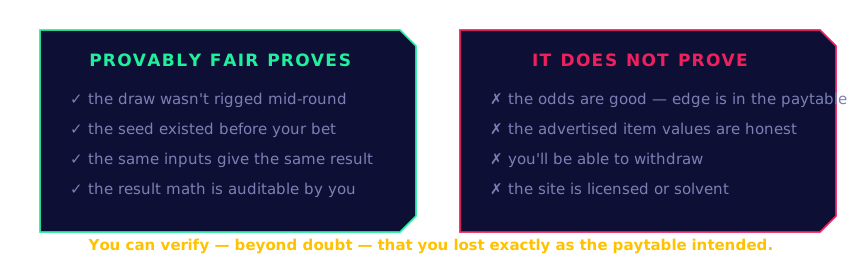
Provably fair verification proves that a result was computed honestly from seeds the casino committed to in advance — it says nothing about whether the game was worth playing. House edge lives in the paytable, not in the random number, so a perfectly verifiable game can take any cut the operator chooses. When you verify a losing bet, what you have proven is that you lost fairly.
What does provably fair actually prove?
Only the mapping: committed seeds went in, the advertised formula ran, this result came out, nothing was altered after your bet. That is genuinely valuable — it rules out the classic rigging scenario. But the scheme is completely silent about the step before the seeds: who decided that a 49.5% win chance pays 2x instead of 2.02x, or that the rare knife sits behind a 0.05% ticket range. If the basics are new to you, start with What Is Provably Fair? — this article is about everything the seeds cannot see.
Where does the house edge hide?
- Dice-style games: the payout formula. The widely documented construction pays
multiplier = 99 / winChance— that 99 instead of 100 is a 1% house edge, sitting in plain sight in the paytable while every roll verifies perfectly. - Crash: baked into the multiplier formula itself. In the bustabit-style scheme that most crash games descend from, the constant in the crash-point equation and the resulting instant-crash probability produce the edge (around 1% in the original) before anyone places a bet.
- Case openings: the odds table times the item values. The site publishes per-item odds, prices the case, and the gap between the case price and the odds-weighted item value is the edge. This one varies enormously from case to case, which is exactly why you should compute it.
A worked example: verifiable, and still a losing bet
Take a fictional but realistic $6.50 case with published odds and honest market values:
| Item | Odds | Market value | EV contribution |
|---|---|---|---|
| Covert knife | 0.05% | $1,400 | $0.70 |
| Covert rifle | 1.95% | $120 | $2.34 |
| Classified skin | 8.00% | $18 | $1.44 |
| Restricted skin | 35.00% | $2.60 | $0.91 |
| Mil-spec filler | 55.00% | $0.90 | $0.50 |
The odds sum to 100%, and the expected value is the sum of the right-hand column: $5.89 per open. On a $6.50 case that is a return-to-player of about 90.6%, a 9.4% house edge, and only 10% of opens (the top three rows) return more than the case costs. Every single one of those opens can be provably fair. The knife odds are real, the rolls are honest, the commitment verifies — and the case still costs you about $0.61 per open on average, forever.
What is RTP, and how does it relate to house edge?
RTP (return to player) is simply 100% minus the house edge: our example case has a 90.6% RTP and a 9.4% edge — two names for the same number. Two warnings apply. RTP is a long-run average, not a per-session promise — a 90.6% RTP case will happily eat twenty opens in a row, and the average only asserts itself over thousands of trials. And on skins sites the value side of the equation depends on item pricing: if the site values a skin above what you can actually sell it for, the effective RTP is lower than the published odds suggest. Use market prices, not site prices, when you do the math.
How do I compute EV myself?
- Find the published per-item odds — case sites with provably fair openings, such as Flamecases and DaddySkins, list odds per case. No published odds means no computable EV, which is itself an answer.
- Price each item at what you could genuinely sell it for, not at the site's displayed value.
- Multiply each item's odds by its value and sum — that is the expected value of one open.
- Divide by the case price. Below 1.0 is the house edge you are paying; compare across cases and across sites before you open anything.
So is a provably fair game worth playing?
Provably fair is a floor, not a recommendation. It should be the first thing you check — a site that fails it, or does not commit a hash at all, is not worth your deposit, and you can test any site's implementation with our verification walkthrough and the verifier tool. But past that floor, the questions that decide what the game costs you are the boring ones: What is the edge? Are the odds published? Do withdrawals actually clear? Sites like CSGORoll document their fairness scheme well, and that is genuinely to their credit. It still does not change the arithmetic of any individual case or game mode. The same applies to multiplayer modes, where the battle mechanics can be airtight while the cases inside them carry the entire cost — see our multiplayer fairness breakdown.
Can a provably fair game have any house edge it wants?
Yes. The scheme constrains how results are drawn, not what they pay. A 40% edge verifies exactly as cleanly as a 1% edge.
Does a 90% RTP mean I get 90% of my money back?
No — it means the average of a very large number of opens converges toward 90%. Your session can and regularly will do much worse.
A house edge is, by definition, an expected loss: play with money you have already decided to spend on entertainment, never with money you need back. If gambling stops feeling like entertainment, stop — and use the site's self-exclusion tools, which any operator worth reviewing provides.