
A real provably fair system has moving parts you can touch: a hash shown before you bet, a client seed you can change, a nonce that counts up, a seed you can force the site to reveal, and a formula you can run yourself. A fake one has a badge. The seven red flags below are the exact checks we run when scoring the Bonuses & Provably Fair axis in our review methodology — each takes under a minute, and a site that fails several of them is asking you to take fairness on faith.
Why do sites fake provably fair?
Because the phrase converts. "Provably fair" has become the niche's trust shorthand, so it appears on sites that implement the full commit-reveal scheme and on sites that implement nothing beyond the words. The history of how real sites have rigged or abused their systems shows even genuine implementations have gaps — a fairness page with no substance behind it deserves zero benefit of the doubt.
What are the 7 red flags?
1. No server-seed hash before you bet
The entire scheme rests on the site committing to its seed before your wager, by showing you a hash of it. If you cannot find a hashed server seed anywhere in the fairness panel before playing, there is no commitment and nothing to verify later. This is the single fastest disqualifier. What the hash does and why it matters is covered in our provably fair explainer.
2. You can't set your own client seed
The client seed is your half of the randomness. If the site generates it for you and offers no way to change it, the operator effectively controls both inputs — and as the CSGODiamonds case showed, an operator who knows both seeds can compute your future results while every roll still "verifies." A visible, editable client seed field is table stakes.
3. No nonce, or no bet counter you can see
The nonce ties each bet to one position in the sequence, so the site can't reorder or cherry-pick outcomes within a seed pair. If the fairness panel shows no nonce, or it doesn't increment as you bet, outcomes aren't pinned to your bets in any checkable way. The role each input plays is laid out in server seed, client seed, nonce explained.
4. The server seed is never revealed
A hash you can never check against a revealed seed proves nothing. Real systems let you rotate your seed, which retires the old server seed and reveals it in plain text — that reveal is the moment past bets become verifiable at all. No rotation button, no reveal, no verification. See why and when to rotate your server seed.
5. The "verify" button only works on their site
A verify widget that runs on the operator's own servers, with an undocumented formula, asks you to trust the site to police itself. A genuine implementation documents the algorithm precisely enough that you — or any third-party calculator — can recompute outcomes independently. If the formula is a secret, the proof is a promise. Our walkthrough on verifying a roll yourself shows what independent verification looks like.
6. The odds behind the game are unpublished
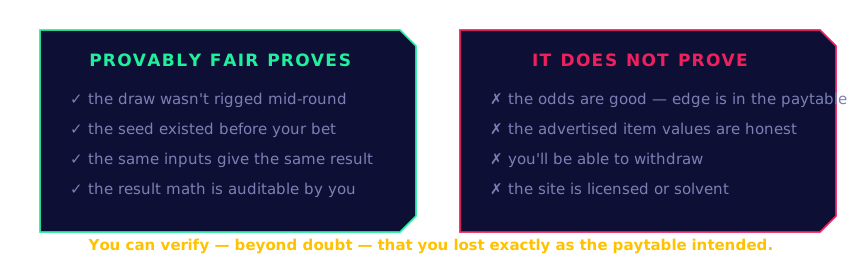
This one catches honest-looking sites. Provably fair proves the outcome mapping was followed — it says nothing about whether the mapping is any good. A case with unpublished item odds, or a game with no stated edge, can verify perfectly while paying out terribly. If you cannot compute the expected value of a case from numbers the site publishes, fairness is only half-checkable. The full argument is in provably fair vs house edge.
7. An audit badge with no report behind it
Certification logos are the cheapest trust signal in gambling. A real audit comes with a named auditor, a dated report, and a scope you can read; a fake one is a JPEG in the footer. Click every badge. If it links nowhere, or to the auditor's homepage rather than a report covering this site, treat it as decoration.
What should you do when a site fails these checks?
One missing piece can be sloppiness; several together are a pattern. Our position is simple: don't deposit on a site where you can't independently verify at least its original games. In our own reviews, this is why hedging matters — RustMoment advertised provably fair games while racking up withdrawal complaints and then went dark, and RustStake operates with no gambling licence we could find, which makes its fairness claims exactly as strong as your ability to check them. On the other side, Gamdom publishes hashes for its originals and DaddySkins runs provably fair case openings — the baseline every site should meet.
How does this feed into our ratings?
Every review on highlighted.gg scores fairness as one of four axes, and the checks above are that axis's checklist: commitment present, seeds rotatable and revealed, formula documented, odds published. A site that fails flags 1–4 cannot score above the middle of the band no matter how good its games look. The full rubric — including what we test with real deposits — is published in how we rate.
Passing all seven flags means the site can't silently alter outcomes. It does not mean you'll win — every game still carries a house edge. Gamble with money you can afford to lose; support is free at BeGambleAware.org. 18+.